Turkey’s Airspace Tantrum Won’t Ground India.
Turkey’s attempt to block India’s Apache delivery by denying airspace wasn’t a show of strength — it was Ankara’s latest display of insecurity. This article breaks down why Turkey’s move failed, why India remains unaffected, and how Ankara only damaged its own credibility.
Pratik Saxena
11/14/20252 min read
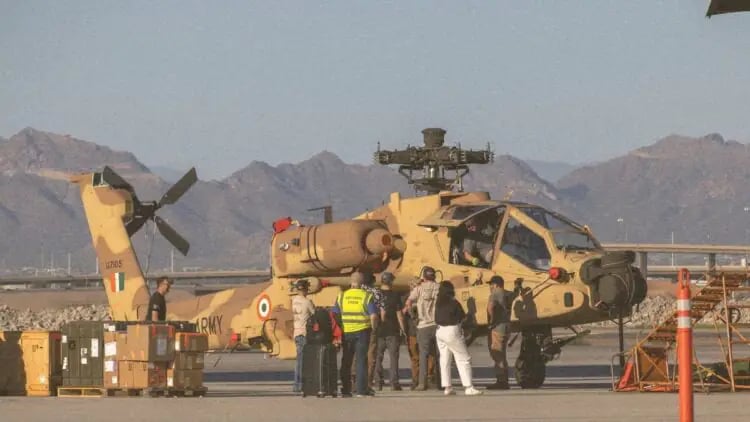
In a move that reflects poor diplomatic judgement and unmistakable insecurity, Turkey has denied airspace clearance to a heavy-lift cargo aircraft transporting India’s remaining batch of AH-64E Apache attack helicopters. The aircraft, which had taken off with the final set of Apaches for the Indian Army, was forced to divert after Turkey abruptly refused overflight permission.
The denial was not a routine bureaucratic formality. It was a deliberate political gesture — an attempt to inconvenience India’s military procurement at a time when Turkey is visibly aligning itself with narratives hostile to India.
But if Ankara believed this would slow India down, it miscalculated. Instead, it has only shown the world how unreliable and inconsistent Turkey has become as a transit state in global defence logistics.
To understand the magnitude of this action, one must consider the strategic importance of the Apache helicopters themselves. The Indian Army signed a major deal with Boeing in 2020 for six AH-64E helicopters, envisioned to provide deep-strike capability, anti-armour operations, and precision engagement in high-altitude and frontier environments. The first batch of three was delivered earlier in 2025, but the second batch, which was supposed to arrive by late 2025, has now been delayed.
Blocking a defence transport aircraft is not a show of strength but it is a confession of insecurity.
A mature nation does not weaponize airspace against a country with which it has no direct conflict.
A capable state does not sabotage supply routes to gain attention.
Türkiye’s air-space denial is not an isolated logistics hiccup—it is a diplomatic gambit with direct defence consequences. It reminds India that hardware deals are only as reliable as the network of states and routes that support them. Against a backdrop of intensified regional rivalry, India’s next challenge will be not just acquiring advanced platforms, but securing the corridors that deliver them safely to its forces.
Alternate Delivery Strategy for India
1) Middle-East transit corridor: The heavy-lift transport aircraft (such as the Antonov An-124) can fly from the United States to the Gulf region (for example via UAE or Qatar) and then proceed over Saudi Arabia, Oman or Iran airspace into India. This longer path bypasses Turkey entirely and uses states with which India already has strong aviation and defence ties.
2) Sea-plus-air hybrid: If air routes remain uncertain, part of the transport could be shifted to maritime shipment for the bulk load, with the final leg flown or ferried via Indian airports. While slower, this Option provides redundancy and reduces dependency on a single air-corridor.
3) European north / Central Asia route: Another possibility is a swing northwards — from Europe through the Baltic or Caspian air-corridor, then via Kazakhstan or Uzbekistan into Pakistan–India region, or via the UAE again. This route adds time but keeps the cargo airborne and secure.
Routes can be blocked, but India’s rise cannot... and Turkey just reminded the world why !