S-500 Prometheus: The System That Could Redefine India’s Air-Defence Superiority
India is exploring the Russian S-500 air-defence system, a major upgrade over the S-400 that could give New Delhi a decisive edge over Pakistan and China.
Pratik Saxena
12/3/20252 min read
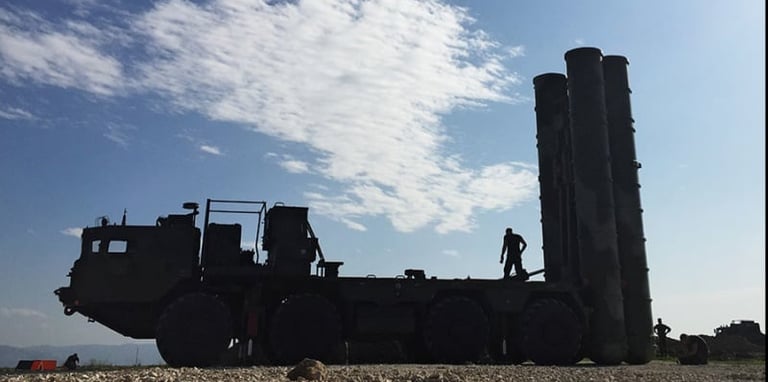
India’s air-defence network may soon undergo its most significant transformation in decades. New Delhi is exploring the acquisition of Russia’s S-500 Prometheus, a next-generation missile-defence system capable of intercepting stealth aircraft, hypersonic missiles and ballistic threats at far greater ranges and altitudes than any system India currently fields.
This development comes at a time when both Pakistan and China are modernising their missile inventories, underscoring why the S-500 could become a crucial pillar of India’s long-term security architecture.
A Leap Beyond the S-400
India already operates the Russian S-400 Triumf, widely regarded as one of the world’s best long-range air-defence systems. But the S-500 represents a different class entirely.
Key Differences: S-500 vs. S-400
Altitude Coverage:
S-400 can intercept targets up to ~30–35 km altitude; S-500 pushes interception into the upper atmosphere, reaching 150–200 km+ depending on missile type.Hypersonic Engagement:
S-400 can challenge some high-speed threats, but the S-500 is specifically engineered to take down hypersonic glide vehicles and ultra-fast ballistic targets.Radar Architecture:
The S-500 uses next-gen radars with extended tracking ranges, capable of monitoring ballistic missiles earlier in their trajectory.Role Classification:
S-400 is a long-range SAM system.
S-500 functions as a hybrid — part SAM, part ballistic-missile defence shield.
This distinction is what makes the S-500 a true strategic system rather than a purely tactical air-defence asset.
How the S-500 Strengthens India Against Pakistan
Pakistan has no system remotely comparable to the S-400, let alone the S-500. Its air-defence relies on:
medium-range Chinese HQ-16
low-end LY-80 systems
outdated Soviet-era equipment
limited AWACS coverage
An S-500 induction would create an altitude and range gap Pakistan cannot bridge, making Indian strategic assets — airbases, nuclear facilities, command nodes — dramatically more secure.
With S-500 coverage, India gains:
the ability to intercept Pakistani ballistic missiles far earlier
long-range tracking of PAF aircraft before they approach the border
strengthened deterrence that forces Pakistan to rethink escalation
In essence, the S-500 places India’s defensive ceiling far beyond Pakistan’s offensive reach.
The Bigger Challenge: China
China’s missile arsenal is larger and more advanced, including DF-17 hypersonic glide vehicles and multiple ballistic systems.
The S-500’s ability to engage hypersonic or high-altitude threats becomes crucial here.
Against China, the S-500 gives India:
deeper early-warning capability
interception of high-altitude ballistic or quasi-ballistic missiles
improved protection for critical Himalayan and northeastern command zones
the ability to counter Chinese carrier-launched aircraft approaching the Indian Ocean
While China fields advanced air-defence like HQ-9 and HQ-22, its hypersonic defences are still maturing.
The S-500 could give India parity — or even advantage — in high-altitude missile interception.
Where Negotiations Currently Stand
Recent diplomatic signals indicate:
India is preparing to raise the S-500 formally with Russia during high-level summits.
Russia has privately indicated readiness to discuss future export, but only after its domestic requirements are fulfilled.
Talks are at the exploratory and technical-evaluation stage, not contract level.
Co-production or partial technology transfer is being examined as a possibility.
India is analysing integration requirements with existing S-400 and indigenous BMD layers.
In short: the door is open, but the process will be long and deliberate.
A Strategic Shield for the Next Decade
India’s pursuit of the S-500 is not merely a hardware upgrade — it is a strategic signal.
As the threat environment evolves, New Delhi aims to build a layered shield capable of defeating everything from UAV swarms to hypersonic missiles.
If negotiations move forward, the S-500 could become the system that redefines India’s defensive superiority over Pakistan and challenges China’s dominance in long-range strike capability.