India Unleashes MIRV Power: Agni Missile Test Redraws Strategic Balance in Asia
India’s successful MIRV-capable Agni-V test marks a major strategic breakthrough for the nation’s defence forces. Capable of striking multiple targets with a single launch, the missile sends a strong message to China and Pakistan while reshaping Asia’s strategic balance.
Pratik Saxena
5/12/20262 min read
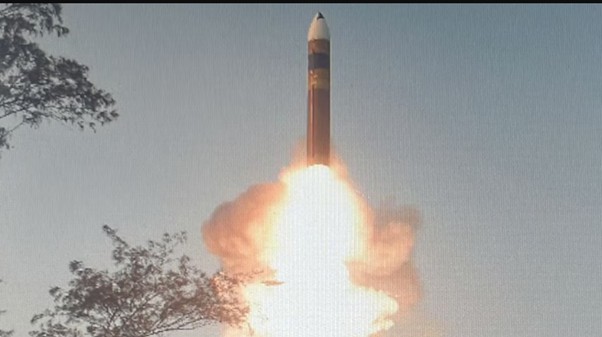
India’s successful test of the MIRV-capable Agni-V marks a major advancement in the country’s strategic defence capabilities. Developed by the Defence Research and Development Organisation (DRDO), the missile demonstrates India’s growing technological strength and its focus on strengthening long-range deterrence in an increasingly tense Asian security environment.
What Makes Agni-V So Powerful ?
Agni-V has an operational range of more than 5,000 kilometers, allowing it to strike targets deep inside Asia and beyond. The missile is a three-stage, solid-fuel intercontinental-class ballistic missile, which gives it faster launch capability, easier mobility, and reduced preparation time compared to liquid-fuel systems. It is road-mobile and can be launched from a canister-based platform, enabling quick deployment and improved survivability during conflict situations.The most significant advancement is its MIRV (Multiple Independently Targetable Reentry Vehicle) capability. This technology allows a single missile to carry multiple nuclear warheads, each capable of striking different targets independently. After reaching the exo-atmospheric phase, the missile releases individual warheads through a highly advanced guidance and separation mechanism, making interception extremely difficult for enemy missile defence systems.
The missile is equipped with advanced ring laser gyroscope-based inertial navigation systems, micro-navigation systems, and highly accurate onboard computers to ensure precision targeting even over intercontinental distances. Agni-V is also believed to possess countermeasure capabilities designed to evade enemy radar tracking and anti-ballistic missile systems. Another major advantage is its canisterized launch system, which keeps the missile sealed and protected for long periods while allowing rapid launch readiness. This significantly enhances India’s second-strike capability, a critical aspect of nuclear deterrence strategy.
Why Agni-V’s MIRV Capability Is a Strategic Nightmare for China and Pakistan?
Unlike traditional ballistic missiles that carry a single warhead, Agni-V can deploy multiple nuclear warheads against different targets during a single launch. This capability dramatically increases the missile’s effectiveness and makes interception by enemy air defence systems extremely difficult. Even if one warhead is intercepted, others can still reach their designated targets, overwhelming missile defence networks.
Agni-V reportedly has a range of over 5,000 kilometers, allowing India to strike strategic locations deep inside Chinese territory while maintaining launch positions within India. The missile uses a three-stage solid-fuel propulsion system, advanced inertial navigation, ring laser gyroscopes, and micro-navigation technology for high precision and rapid deployment. Its canister-based launch platform further enhances mobility, survivability, and quick-response capability during emergencies.
For China, the missile represents a major strategic concern because it strengthens India’s second-strike nuclear capability. China already operates advanced MIRV-capable systems such as the DF-41, and India’s progress narrows the technological gap in long-range strategic warfare. Agni-V’s ability to target multiple high-value military or infrastructure locations simultaneously could complicate Chinese missile defence planning in a potential conflict scenario.
For Pakistan, the challenge is even greater. Pakistan’s missile defence infrastructure remains comparatively limited, and the presence of a MIRV-capable Indian missile significantly increases pressure on its strategic deterrence structure. A single Agni-V launch could potentially threaten multiple strategic assets at once, making conventional interception extremely difficult.
“वीर भोग्या वसुंधरा”